

Mola Mola: The Ocean’s Giant, Gentle Oddball
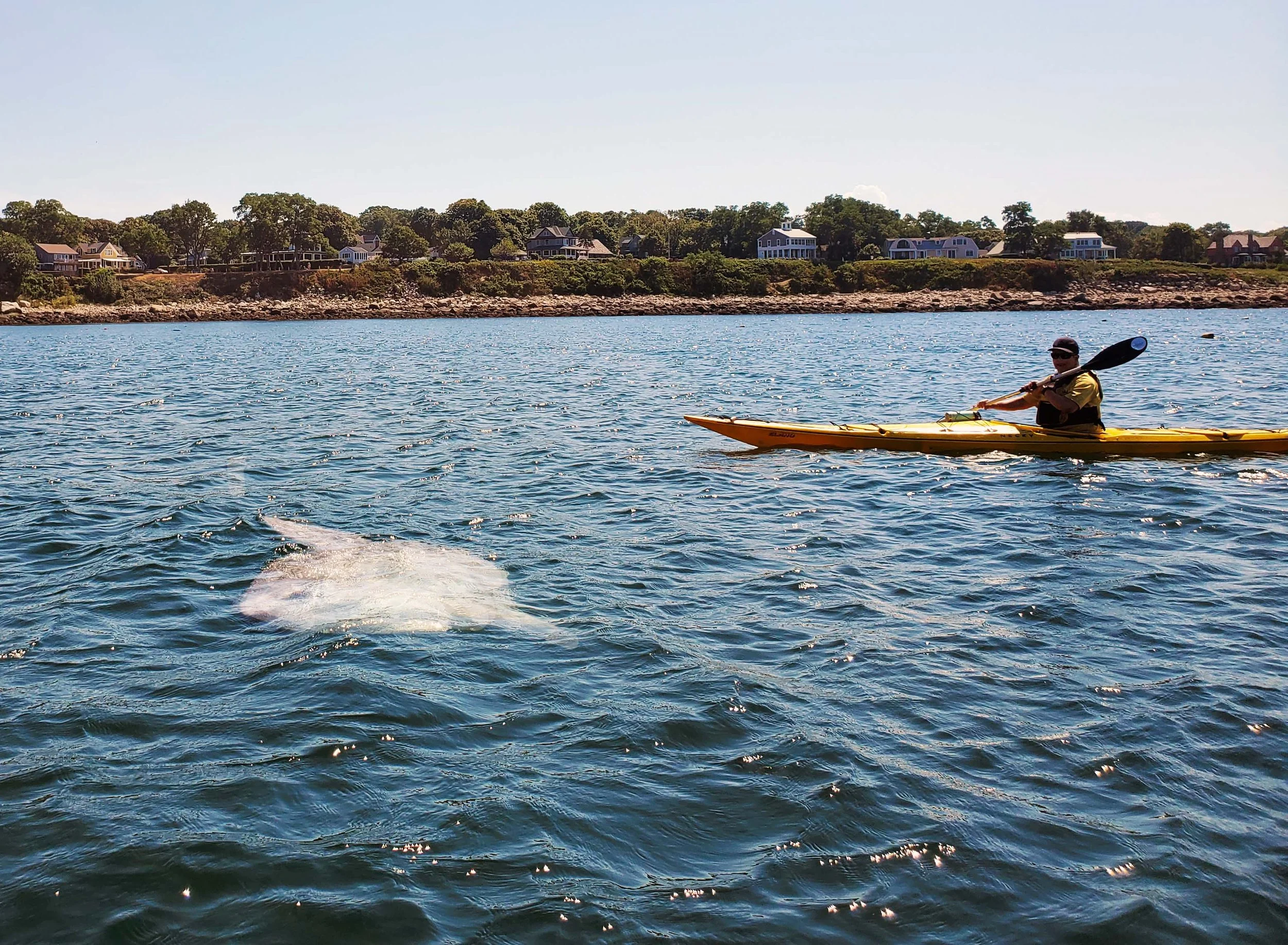
Ocean Sunfish (Mola mola) as seen here on a Coastal Tour in August in Rockport, MA (color contrast edited to see it better.)
If you could design a fish with complete creative freedom—no rules, no expectations—you might end up with something like the Mola mola, also known as the ocean sunfish. It’s enormous, oddly shaped, a little mysterious, and somehow both majestic and awkward at the same time. And despite looking like it was assembled from spare parts, it’s one of the most fascinating creatures in the sea.
Let’s dive into the strange and wonderful world of the Mola mola.
What Is a Mola Mola?
The Ocean Sunfish (Mola mola) is the heaviest bony fish in the world. Fully grown, they can weigh over 2,000 kilograms (4,400 pounds) and measure up to 3 meters (10 feet) from fin to fin. That’s about the size of a small car—except it swims……..sometimes.
Unlike most fish, Mola molas don’t have a typical tail (caudal fin). Instead of a flowing rear fin, they have a stubby, rounded structure called a clavus, which looks like someone neatly trimmed off the back half of the fish. Their bodies are flattened sideways, giving them the appearance of a giant swimming dinner plate. So if they don’t have a caudal fin how do they swim you ask? They utilize balistiform locomotion, which is named after the group of fish including triggerfish, and filefish, and utilizes a wave-like undulating back and forth motion of their dorsal and anal fins. More on that later.
They also have tiny mouths with fused teeth that form a beak-like structure. Cute? Slightly. Strange? Absolutely.
We were expecting to show our guest, Amaka Ubaka, lots of seals, when this thing showed up!
Why Are They Called “Sunfish”?
The name “sunfish” comes from a behavior that puzzled sailors for centuries: Mola molas often float on their sides at the ocean’s surface, basking in the sun.
For a long time, people thought they were sick or dying. But scientists now believe this sunbathing helps them warm up after deep dives into colder waters. It may also attract seabirds that pick parasites off their skin—basically, a floating spa day.
Surprisingly Athletic (In Their Own Way)
At first glance, Mola molas don’t look built for speed or agility. But they are surprisingly capable swimmers.
They propel themselves using their large dorsal and anal fins, flapping them in a synchronized motion. It’s not the fastest swim in the sea, but it’s efficient enough to travel long distances. In fact, satellite tracking has shown that Mola molas migrate across entire ocean basins. But more than anything they prefer to just drift with the ocean currents which allows them to get pushed and concentrated wherever the jellyfish are, their main food source.
They’ve also been known to dive hundreds of meters deep in search of food.
What Do They Eat?
Mola molas primarily feed on:
Jellyfish
Salps
Small fish
Zooplankton
Because jellyfish are low in calories, mola molas need to eat a lot of them to maintain their massive size. Think of it as surviving on oceanic cotton candy.
Despite their size, they are not aggressive and pose no threat to humans.
When do we see them?
Here in Rockport MA, our waters reach peak temperature around August, which also happens to be when the Gulf Stream shifts closer to our shores. This warm water, combined with the upwelling that is created from deep nutrient rich ocean water is what creates plankton, jellyfish and ctenophores blooms, and brings in the Mola molas! So if you are on the hunt for Mola molas we would love for you to join us on one of our kayak tours. You are most likely to see them on our longer tours, like the seal tour or Island tour, but occasionally we’ll even see some on our Coastal Tour!
From Tiny to Titanic
One of the most mind-blowing facts about mola molas is how they start life.
They hatch from eggs that are only a few millimeters wide. The larvae look nothing like the adults—more like tiny, spiky pufferfish. As they grow, they undergo a dramatic transformation, eventually losing the typical fish tail and developing their iconic rounded shape.
A female mola mola can produce up to 300 million eggs at a time, one of the highest fecundity rates among vertebrates. Nature clearly believes in a “strength in numbers” strategy.
Are They in Danger?
While mola molas are not currently classified as endangered worldwide, they face several threats:
Bycatch in fishing nets
Plastic pollution (mistaken for jellyfish)
Boat strikes
Ocean warming and ecosystem shifts
Conservation efforts are ongoing, especially in regions where bycatch significantly affects their populations. Occasionally they are found beaching themselves in Cape Cod and the islands. When found still alive they are often towed offshore and released.
Mola mola rescue on Nantucket Island.
The Internet’s Favorite Fish
In recent years, Mola molas have gained a kind of cult celebrity status online. Their perpetually confused expressions and unconventional shape have made them the subject of countless memes, affectionate jokes, and don’t forget about those viral Youtube videos!
But beyond the humor lies something important: mola molas remind us how diverse and strange life on Earth truly is. Not everything has to look sleek and streamlined to thrive.
It’s a baby whale, Jay, get it to the New England Aquarium!
Final Thoughts
The Mola mola challenges our expectations of what a fish “should” look like. It’s massive yet gentle. Clumsy-looking yet capable of crossing oceans. Strange yet perfectly adapted to its environment.
In a sea full of sharks, dolphins, and sleek predators, the mola mola floats proudly—like a giant, sunbathing pancake with a purpose.
And honestly, the ocean wouldn’t be nearly as interesting without it.